Today (25.11.2019), TINT is organizing a little event about the 2019 Nobel Prize in Economics (see the poster below). For those who are unable to attend, I prepared a quick reading list that contains some articles about the 2019 Prize as well as some critical perspectives about the work of Nobel Laureates. Of course, this … Continue reading 2019 Nobel Prize in Economics: A Reading List

Blog
A summer reading list for students of Philosophy of Economics
I prepared this list for my Philosophy of Economics students (Erasmus School of Economics, Erasmus University Rotterdam). Most books in this list should be interesting even if you do not like philosophy of economics, but they are related to the topics we have discussed in class. Of course, they will be even more interesting if you … Continue reading A summer reading list for students of Philosophy of Economics
CFP: Synthese Special Issue on Unrealistic Models
Call for Papers Synthese Special Issue WHAT TO MAKE OF HIGHLY UNREALISTIC MODELS? Guest Editors: N. Emrah Aydinonat, Uskali Mäki, and Till Grüne-Yanoff What to make of highly unrealistic models? This is one of the big questions in contemporary philosophy of science, especially in philosophy of economics and biology. We consider two set of issues … Continue reading CFP: Synthese Special Issue on Unrealistic Models
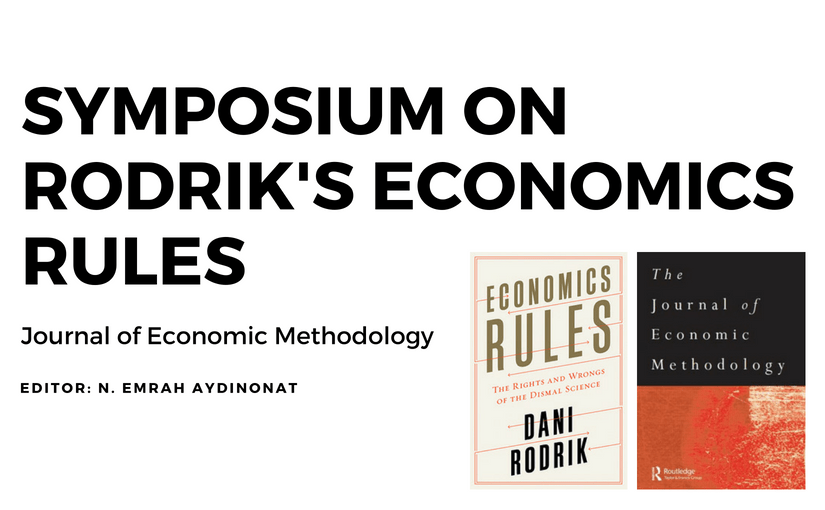
Symposium on Dani Rodrik’s Economics Rules
The latest issue of the Journal of Economic Methodology (2018, 25/3) is a special issue on Dani Rodrik's Economic Rules. It consists of the following articles: Philosophy of Economics Rules: introduction to the symposium - N. Emrah Aydinonat. doi: 10.1080/1350178X.2018.1503143 Pre-print available on ResearchGate. Rights and wrongs of economic modelling: refining Rodrik - Uskali Mäki. Available … Continue reading Symposium on Dani Rodrik’s Economics Rules
Philosophy of Economics Rules: introduction to the symposium
ABSTRACT: Economists have long been criticized for their use of highly idealized models. In Economics rules: Why economics works, when it fails, and how to tell the difference [Oxford: Oxford University Press, 2015] Dani Rodrik responds to this criticism by offering an account of models that emphasizes the diversity of models in economics. Rodrik's account presents … Continue reading Philosophy of Economics Rules: introduction to the symposium
Introduction to The Invisible Hand in Economics (Routledge, 2008)
This is the Introduction to The Invisible Hand in Economics: How Economists Explain Unintended Social Consequences (Routledge, 2008). If you prefer to read the PDF version, it is available on ResearchGate. Everyone is familiar with the (aesthetically) unpleasant walking-paths on public green fields. Usually, around these fields there are constructed paths for the service … Continue reading Introduction to The Invisible Hand in Economics (Routledge, 2008)
The Invisible Hand in Economics: How Economists Explain Unintended Social Consequences
The Invisible Hand in Economics How Economists Explain Unintended Social Consequences INEM Advances in Economic Methodology London: Routledge, 2008. This is a book about one of the most controversial concepts in economics: the invisible hand. The author explores the unintended social consequences implied by the invisible hand and discusses the mechanisms that bring about these … Continue reading The Invisible Hand in Economics: How Economists Explain Unintended Social Consequences
Understanding with theoretical models
ABSTRACT. This paper discusses the epistemic import of highly abstract and simplified theoretical models using Thomas Schelling's checkerboard model as an example. We argue that the epistemic contribution of theoretical models can be better understood in the context of a cluster of models relevant to the explanatory task at hand. The central claim of the … Continue reading Understanding with theoretical models
The diversity of models as a means to better explanations in economics
ABSTRACT. In Economics Rules, Rodrik [(2015). Economics rules: Why economics works, when it fails, and how to tell the difference. Oxford: Oxford University Press] argues that what makes economics powerful despite the limitations of each and every model is its diversity of models. Rodrik suggests that the diversity of models in economics improves its explanatory capacities, but … Continue reading The diversity of models as a means to better explanations in economics
Philosophy of Economics – Syllabus
This semester I am teaching the Philosophy of Economics course at the Erasmus University Rotterdam to the students of Erasmus School of Economics. Here is the Syllabus, which also includes a reading list. Comments and suggestions are welcome.